On this page...
Location
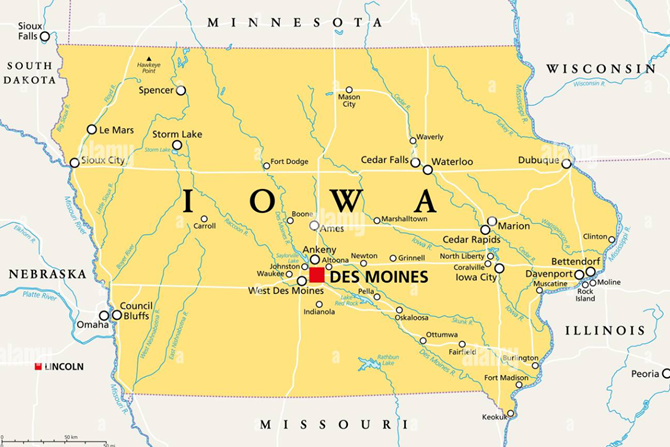
Iowa is in the upper Midwest. It borders Minnesota to the north; Wisconsin and Illinois to the east; Missouri to the south; and Nebraska and South Dakota to the west. Two major rivers define the state: the Mississippi River on the east and the Missouri River on the west, making Iowa the only U.S. state with two parallel river borders. The landscape is made up of gently rolling plains and fertile farmland. Iowa covers about 56,273 square miles, ranking 26th in size among U.S. states, and has a population of roughly 3.2 million people.
Statehood
Iowa became the 29th U.S. state on December 28, 1846. Its name comes from the Ioway (or Iowa) Native American tribe, whose name is thought to mean one who puts to sleep or sleepy ones. The area was first recorded by French Jesuit missionary Jacques Marquette in 1673. It later belonged to French and then Spanish Louisiana before becoming part of the United States through the Louisiana Purchase.
Back to topFlag
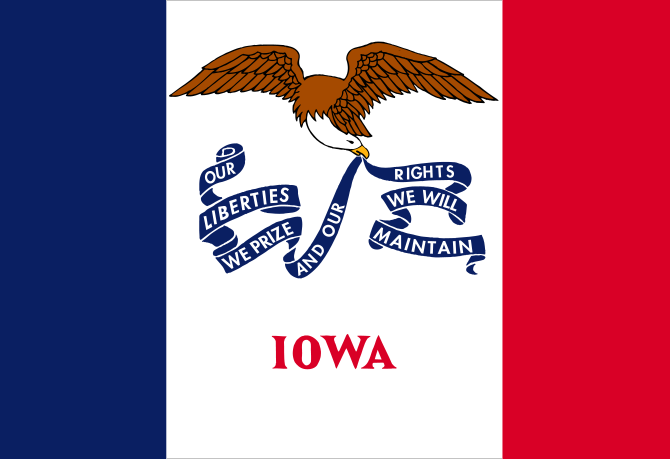
The flag of the U.S. state of Iowa is a vertical tricolor flag designed by Dixie Cornell Gebhardt in 1917. Iowa legislators officially adopted the flag in 1921. It is one of nine U.S. state flags to feature an eagle.
Nickname
Iowa is nicknamed the Hawkeye State and has 99 counties. Des Moines, the capital and largest city, is a hub for finance, insurance, and cultural institutions.
The nickname Hawkeye originated from a combination of literary, historical, and promotional influences. The earliest inspiration comes from James Fenimore Cooper’s 1826 novel "The Last of the Mohicans," which featured a skilled frontiersman named Hawkeye, admired for his marksmanship and wilderness knowledge. Early Iowa settlers and promoters saw Hawkeye as a symbol of the rugged, independent spirit they wanted to associate with the territory.
Today, the nickname is most prominently associated with the University of Iowa, whose athletic teams are called the Hawkeyes, and the mascot, Herky the Hawk, serves as a widely recognized symbol of the state.
Back to topAgriculture and Economy
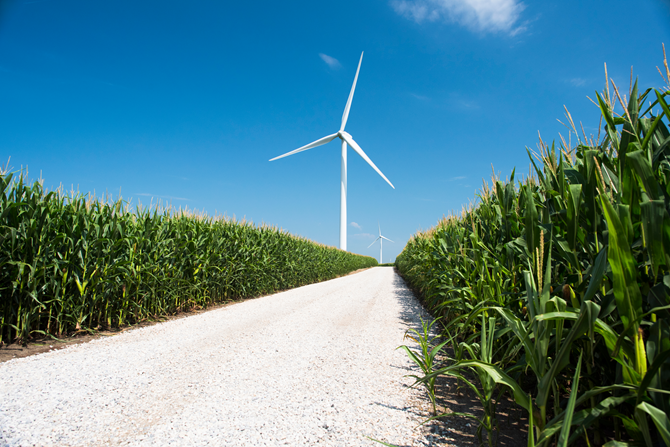
Iowa is a national leader in agriculture, with more than 90% of its land used for farming. The state produces large amounts of corn, soybeans, and livestock, supported by rich soil, good rainfall, and rolling land that works well for modern farm equipment. Although agriculture is still important, Iowa’s economy has expanded to include banking, insurance, biotechnology, research and development, and green energy.